Adding a batch axis to picoGPT
If you haven’t already seen Jay Mody’s GPT-2 in 60 lines of NumPy, please read that first. It’s a really detailed explanation and I learnt a ton from it.
I’m forking that repo (MIT-licensed) and adding a few things on top, and sharing what I learn along the way. I’m also adding assertions and testing tools as I go, to check that what I’m coding is actually right and that I’m heading in the right direction. That part matters more than it sounds like it should — inference bugs tend not to crash. They just quietly give you slightly different text.
The plan:
- this post — batching
- post 2 — batching with variable length: padding, and modifying the masks accordingly
- post 3 — KV cache
- post 4 — sampling methodology
- post 5 — the cache as a data structure: preallocation, paging, prefix caching
- post 6 — the scheduler: continuous batching and chunked prefill
- post 7 — same answer, less work: online softmax, FlashAttention tiling, speculative decoding
- post 8 — trading accuracy for memory: quantization, GQA, sliding window
- post 9 — how do you know you didn’t break it: perplexity and evaluation
The first four are about making inference correct. The rest are about making it cheap, and then about how you tell whether cheap cost you anything.
Recap of the code
Here’s the shape of what Jay Mody’s version does, top to bottom:
Encoding to tokens
Generate token by token
    GPT2
        Token embedding + position embedding
        Transformer blocks
            pre-norm multi-head attention
                QKV projections
                split into multiple heads
                get output using attention
                merge heads
                output projection
            pre-norm MLP
                project up
                activation
                project down
        layer norm
        projection to vocab
    Sampling
Decoding to text
Everything in this series changes only the shapes flowing through that, not the structure.
The params and hparams
Also to recap, here are the params and hparams of GPT-2 124M:
{'wte': [50257, 768],                                  # token embeddings
 'wpe': [1024, 768],                                   # position embeddings
 'blocks': [{'ln_1': {'g': [768], 'b': [768]},
             'attn': {'c_attn': {'w': [768, 2304], 'b': [2304]},
                      'c_proj': {'w': [768,  768], 'b': [768]}},
             'ln_2': {'g': [768], 'b': [768]},
             'mlp':  {'c_fc':   {'w': [768, 3072], 'b': [3072]},
                      'c_proj': {'w': [3072, 768], 'b': [768]}}},
            ...                                        # x n_layer = 12
           ],
'ln_f': {'g': [768], 'b': [768]}}{'n_vocab': 50257, 'n_ctx': 1024, 'n_embd': 768, 'n_head': 12, 'n_layer': 12}A few things worth reading off that:
2304 = 3 × 768— Q, K and V are one fused projection, which is whymhastarts with a singlelinearfollowed bynp.split(x, 3, axis=-1).3072 = 4 × 768— the MLP’s 4× expansion.c_fcgoes up,c_projcomes back down, which is why theirwshapes are mirror images.d_head = 768 / 12 = 64.- Nothing in here is per-head. There are no 12 sets of attention weights. The heads are a view of the 768 dimensions, which is exactly why
split_headsis areshapeand not an indexing operation. - There’s no output head either.
x @ wte.Treuses the token embeddings. At 38.6M parameters,wteis 31% of the model, and tying it means that 31% does double duty.
And does it add up?
wte |
38,597,376 |
wpe |
786,432 |
| per block | 7,087,872 |
| × 12 blocks | 85,054,464 |
ln_f |
1,536 |
| total | 124,439,808 |
Adding the batch axis
In the original post, the author used a single prompt. Now let’s see how to extend this to a batch of prompts, with no loop over the batch. We introduce a batch axis B.
One thing to be clear about up front: in this post all the prompts in the batch are the same length, so a single T describes every prompt in it. Prompts of different lengths need padding and a modified mask, which is post 2. That’s the only real restriction here — the code below works for any B.
All the code below lives in gpt2_v1_batching.py.
Let’s go step by step through where the changes happen. Figure 1 is the whole thing with the batch axis threaded through — every shape below refers back to it.
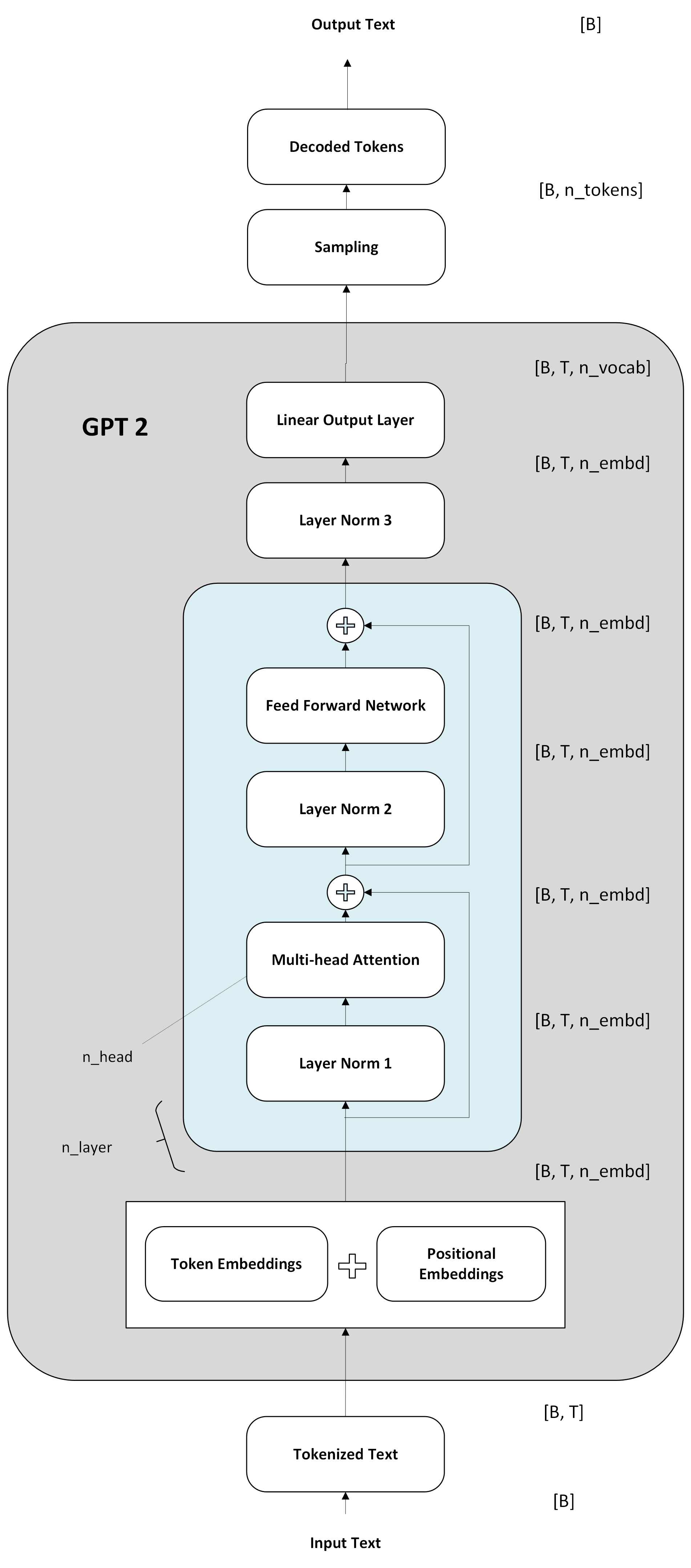
generate
The logits now come back for every prompt in the batch, so the shape is [B, T, n_vocab].
We’re still doing greedy decoding, but we have to take the last position of each prompt in the batch — hence logits[:, -1] — and then concatenate the new tokens onto the input all at once with np.concatenate. next_ids[:, None] is there to turn [B] back into [B, 1] so it can be concatenated along the time axis.
def generate(input_ids, params, n_head, n_tokens_to_generate):
    # input_ids: [B, T]
    for _ in tqdm.tqdm(range(n_tokens_to_generate)):
        logits = gpt2(input_ids, **params, n_head=n_head)   # [B, T, n_vocab]
        next_ids = np.argmax(logits[:, -1], axis=-1)        # greedy: [B]
        input_ids = np.concatenate([input_ids, next_ids[:, None]], axis=-1)

    return input_ids[:, -n_tokens_to_generate:]             # [B, n_tokens_to_generate]
gpt2
wpe can be customised per sequence when the sequences have different lengths, but here every prompt has the same length, so we just take T and let it broadcast over the batch. (For prompts of different lengths we’d take the max token length and pad — post 2.)
Everything else stays the same, except that a batch dimension has been added to each matrix.
def gpt2(input_ids, wte, wpe, blocks, ln_f, n_head):
    # input_ids: [B, T]
    T = input_ids.shape[-1]

    # token embedding [B, T, n_embd] + position embedding [T, n_embd] (broadcasts over B)
    x = wte[input_ids] + wpe[np.arange(T)]

    for block in blocks:
        x = transformer_block(x, **block, n_head=n_head)   # [B, T, n_embd] -> [B, T, n_embd]

    x = layer_norm(x, **ln_f)                              # [B, T, n_embd]

    return x @ wte.T   # [B, T, n_embd] @ [n_embd, n_vocab] -> [B, T, n_vocab]
transformer_block
Again the code is unchanged apart from the batch dimension being carried along.
def transformer_block(x, mlp, attn, ln_1, ln_2, n_head):
    # pre-norm multi-head attention
    x = x + mha(layer_norm(x, **ln_1), **attn, n_head=n_head)   # [B, T, n_embd]
    # pre-norm feed forward
    x = x + ffn(layer_norm(x, **ln_2), **mlp)                   # [B, T, n_embd]
return xlinear, layer_norm, softmax, gelu and ffn need no changes at all. They already reduce over axis=-1 with keepdims=True, and @ broadcasts over any number of leading dimensions, so they work on [T, d], [B, T, d] or [B, H, T, d] without touching them. If any of them had been written with a positive axis index — np.mean(x, axis=1), which is a perfectly natural thing to write when x is 2-D — every one would need editing now.
mha
This is where more of the changes happen.
With the extra batch dimension, we need to split the heads accordingly using reshape and transpose. And instead of calculating attention for each head in a Python loop, we calculate all of them at once. Once attention is computed, we convert the output back to [B, T, n_embd] by merging the heads.
def mha(x, c_attn, c_proj, n_head):
    # x: [B, T, n_embd]
    B, T, n_embd = x.shape
    d_head = n_embd // n_head

    x = linear(x, **c_attn)             # [B, T, n_embd] -> [B, T, 3 * n_embd]
    q, k, v = np.split(x, 3, axis=-1)   # each [B, T, n_embd]

    # split the feature axis into heads, then move heads next to batch:
    # [B, T, n_embd] -> [B, T, H, d_head] -> [B, H, T, d_head]
    def split_heads(t):
        return t.reshape(B, T, n_head, d_head).transpose(0, 2, 1, 3)

    q, k, v = split_heads(q), split_heads(k), split_heads(v)

    # causal mask: 0 where j <= i, -1e10 where j > i. [T, T]
    mask = (1 - np.tri(T, dtype=x.dtype)) * -1e10

    # one batched call handles every (batch, head) pair
    out = attention(q, k, v, mask)      # [B, H, T, d_head]

    # merge heads back: [B, H, T, d_head] -> [B, T, H, d_head] -> [B, T, n_embd]
    x = out.transpose(0, 2, 1, 3).reshape(B, T, n_embd)

    x = linear(x, **c_proj)             # [B, T, n_embd] -> [B, T, n_embd]
    return x
attention
To accommodate the multi-head calculation, we swap the axes of k, do the scaled dot product, and return an output matrix of size [B, H, T, d_head].
np.swapaxes(k, -1, -2) and not k.T. This is the one I’d have got wrong if I hadn’t been watching the shapes: k is 4-D now, and .T reverses all four axes, giving [d_head, T, H, B]. What we want is to swap only the last two. .T on anything more than 2-D is almost always a bug.
def attention(q, k, v, mask):
    # q, k, v: [B, H, T, d_head], mask: [T, T] (broadcasts over B, H)

    # [B, H, T, d_head] @ [B, H, d_head, T] + [T, T] -> [B, H, T, T]
    scores = q @ np.swapaxes(k, -1, -2) / np.sqrt(q.shape[-1]) + mask

    # [B, H, T, T] @ [B, H, T, d_head] -> [B, H, T, d_head]
    return softmax(scores) @ v
Checking it
The claim for this post is narrow: a batch of one must produce exactly what the original produces. Nothing about the math changed, only the shapes.
def test_gpt2_vs_batched_logits():
    expected = gpt2.gpt2(prompt, **params, n_head=n_head)
    actual = gpt2_v1_batching.gpt2(
        prompt[None, :], **params, n_head=n_head
    )[0]

    np.testing.assert_allclose(actual, expected, rtol=1e-12, atol=1e-12)
It passes. prompt[None, :] adds the batch axis of one, and [0] takes the row back out — so both sides are [T, n_vocab] and comparable. The full thing is in test_gpt2.py.
It runs against a tiny random model — n_vocab=17, n_embd=12, n_head=3 — so it takes a second and doesn’t need the 124M download. Equivalence is a property of the code, not the weights.
A tolerance of 1e-12 is tighter than float32 can represent, so this is really asking for bit-identical output. Which is the right ask here, because nothing in this version reorders an arithmetic operation.
What batching actually buys
Batching doesn’t reduce the arithmetic — it reduces how many times you read the weights to do it. Load each weight matrix once and use it for every sequence in the batch instead of one. GPUs are fast at math and slow at memory, so this is most of what keeps them from idling — and why serving systems put many users in the same matmul.
Where this is going
Next: prompts of different lengths. That means padding, a mask that knows which positions are real, and position ids that skip the pads.